Writing

Camp NaNoWriMo or How I (Re)Learned to Love NaNo

I first hopped onto the National Novel Writing Month (NaNoWriMo) bandwagon over ten years ago, during my final year of high school. It was a wild experience that taught me both the perils and benefits of writing so much, so quickly. I loved it so much that I did it again a year later in college, and again and again until I finally failed while foolishly trying to do both NaNo and write my thesis at the same time.

After graduating, I only did NaNo a handful more times before I had a falling out. I thought – erroneously – that I was above and beyond NaNo. In a way, I was – I was already writing every day, even if it wasn’t in great 2k+ bursts. I focused on rewriting and editing what I already had and steered further away from the NaNo community. I even got into a little bit of NaNo bashing, back when that was in vogue. NaNo encouraged shitty writing! NaNo wasn’t conducive to editing and rewriting! NaNo was a celebration of amateurism!

I’ve since moved on from such sentiments, realizing – in part – that NaNo never aspired to be anything more than writing and writing quickly. Some people can actually write a decent book in a month. Some people can’t. All NaNo cares about is that you try. At the end, you’ll have 30+ days of effort, a greater appreciation of authors, and either a will to keep going or an understanding that writing isn’t your thing. And that’s more than enough.

But there’s something else NaNo teaches writers that I think frequently gets glossed over or outright ignored because it’s not sexy or exciting enough: the beauty of a word graph.

Just. Take a moment. Picture a graph. Picture your projected final wordcount on the y-axis. Picture time in days on the x-axis. Imagine putting in your word count at the end of each day and watching the bars or the line slowly rise. Now, picture missing a day. You don’t want to, do you? Picture missing two days – oh god, that’s awful. Look at that sad line. All you want to do is write 50 or 100 words just to make that line move towards it’s goal. So you do. And it does. And you write a little more.

Word graphs are simple but powerful tools. They’re like that little story Seinfeld would tell about his own writing process, where he buys a blank calendar and makes a big red X on every day that he writes. Soon, it’s impossible to break that long streak of X’s. I propose that word graphs are better, because it’s a reward for writing, not a punishment for not writing.

I’ve come back to NaNo in recent years just for that word graph. I made my own, of course, using an excel sheet, but – while it helped me tremendously to stay on track – it lacked that sparkle of magic.

Unfortunately, NaNo right now lines up with my editing and rewriting months. But there’s this thing called Camp NaNoWriMo that’s smaller and takes place in July. Even though there are far less participants, you still have that camaraderie, that social push to write, and – yes – that beautiful graph.

Anybody else going to participate in Camp NaNo this year?


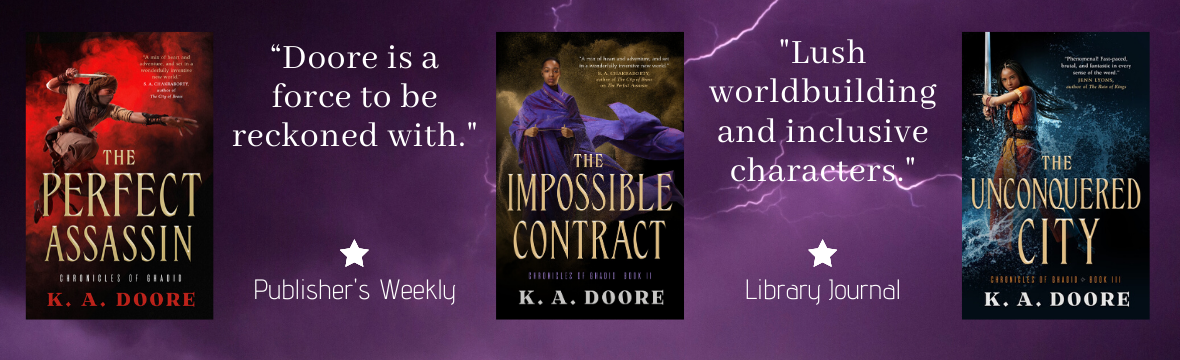
Chronicles of Ghadid Trilogy, The Impossible Contract (Book 2), Writing

What’s to Come

Ever since committing whole-heartedly to being a writer, I’ve taken the time every six months or so to sit down and plan out what I’m going to do next. This keeps me committed, keeps me on schedule, helps me practice hitting deadlines, and reminds me that new projects should always be just around the corner.

As we head into June, I find myself at one of those junctures. It is time – again – to plan out the next few months and to shape where I would like to go. Now that The Impossible Contract is – mostly – done and I have to wait for my second round of queries to go through, I need something else to focus on.

Unfortunately, at least for June, I can’t stray too far. I still have to wait for beta feedback and be ready to make a few last minute edits. When it comes to writing, I’ve tried multitasking on multiple projects and it just doesn’t work.

My solution is actually pretty simple: I won’t stray far. Instead, I’ll play with this short story that has to do with some events that happen off screen in the middle of the book. It’ll be fun and it’ll keep me writing and it shouldn’t be longer than 15k – perfect for a month.

But after that…

Well, July brings Camp NaNoWriMo, which is ideal timing for the start of a new WIP. 30 days and 50k words should give me a pretty good idea of whether or not this next story is workable. Considering I don’t think this story will be longer than 80k – it’s YA, after all – a 50k word draft zero is ideal. I’ve learned that I frequently have to add a lot more to my first draft, which seems to be the opposite of most writers’ processes.

In August, I’ll cool down with some edits and/or research. For TIC, I did draft zero in one big, two month & 80k burst, then I took a month and shored up the research I’d begun while writing. I can see myself doing something similar, even though this new WIP (OIBM) shouldn’t need as much research.

Then September  onwards – rewrite rewrite rewrite. Depending on where I am in the rest of my life (my job might be changing, we might be moving, there might be some other big changes), I’ll set mini goals for those months. I’m not even going to try to set them now, though, since life is quite volatile at the moment.

Ideally, I’ll be done with the first major rewrite by December. If I follow remotely the same trajectory as TIC, then January-February will be the last of my edits before I round up some betas.

But that’s more than six months out, so I’ll reevaluate at that point. As much as I love TIC, I’m really looking forward to starting a new project.

Querying, Writing Tips

#Pitmad Coming Up on June 4th!

Although I have been around the internet since modems made that awful dialing noise while they connected – or rather, tried to connect – and I have been on Facebook and Livejournal and now WordPress since forever, I have had a hard time with Twitter. It’s such a fleeting, ephemeral platform, where there is no past and everything must be condensed into a 140 character soundbite.

Not for want of trying, of course. But my relationship with Twitter has been like a reverse Brokeback Mountain – I can’t stop quitting you. Now that I have a Smart Phone, though, it’s become a tad bit easier. It still seems like the shallowest of the social media forms, but maybe that’s to be embraced instead of rejected.

Plus, there are a ton of writer resources on Twitter that just can’t be found elsewhere. Agents posting their wishlists (#MSWL). Genre-related chats. Industry-related topics (#publishing). Writerly camaraderie and community (#amwriting).

But the resources I am currently the most excited about are the contests. Specifically, the pitch contests. More specifically, #PitMad.

If you are like me and have had your head under a rock for the past few years, then you should know that #PitMad is a quarterly pitch contest on Twitter wherein writers tweet their appropriately-tagged novel pitches into the ether and real live agents read and sort and favorite them. It’s one way to get ahead of the slush pile and/or seize the attention of agents not currently open to unsolicited queries.

The next #PitMad event is just next week: June 4, 2015. That is more than enough time to come up with two-three different pitches, each perfect in their own way and yet also able to build on each other.

So if you’re a writer with a completed and ready-to-query manuscript – come join me in this pitch event! You can follow me on Twitter @KA_Doore.

Book Reviews, Chronicles of Ghadid Trilogy, Writing

Research

In gearing up for my next project, I’ve been brainstorming what I’m going to research, how I’m going to research it, and in what format I want to share that research here. Because it’s going to be all magical girls, all the time, it’ll be a lot of fun – I’m planning to binge watch most of the classic anime series and I’ve been scouring the online world for anything with hints of magical girlness in the book world. From what I’ve seen – so far at least – there isn’t much.

Granted, this could mean that there simply is no market, but I’m willing to bet my time (and possibly sanity) that that is not, in fact, the case.

But as I mused over these things, I realized I’d never shared any of my preliminary research for my current, actually done, novel here. Partially because I was so involved with the process at the time, but also partially because I didn’t think anyone would actually be interested.

Then I thought – I was interested. Surely there might be other people, too.

So I’m going to do a short little series delving into the background of my current novel, The Impossible Contract, the research, and what all came together to make it more than just a tromp through some sandy places.

When the idea for this story first popped into my head, I knew it was going to be set in a desert much like our modern day Sahara. Although I currently live in a bona fide desert, it doesn’t quite have the range of extremes that the Sahara does. That’s when I knew I’d need to read some first hand accounts of what it’s like not only surviving, but thriving, in that kind of environment.

Little did I know the size of the rabbit hole I was about to fall into.

The Sahara and its people and disparate cultures are absolutely fascinating subjects. It is the endless dunes that come to mind when you merely think the word, and it is rocks and wind and mountains and oases, wells and flies and camels and deep underground aquifers, gods and demons and unnamable madness.

But it’s also, you know, everyday people living their lives.

I read more than a dozen books on the Sahara alone, but to start you off, I’d recommend these in particular:


Men of Salt by Michael Benanav
This is a first-hand account of travel with a salt caravan from a western perspective. It’s absolutely fascinating and a great way to introduce yourself to the region, if you don’t previously have any knowledge or experience. Since it’s an outsider’s perspective – and a tourist’s at that – it doesn’t get into the nitty gritty of cultural details and makes some assumptions, but it’s a quick, fun read and I found with follow-up research that most of it was spot on.


Skeletons on the Zahara by Dean King

Also an absolutely fascinating account of shipwrecked Americans adrift in the Sahara. This novel is based on a true story in the early 19th century and was especially interesting to read right after Men of Salt, because so little has changed. While the story suffers from both an overabundance of minutiae and the problematic outsider viewpoint, it shows a lot more of the everyday culture and just what it takes to survive in the Sahara.


Sahara: A Natural History by Marq de Villiers & Sheila Hirtle

This book. This book. If you want an overview of the Sahara – its history, its cultures, its geography – then you should read this. This book made me absolutely fall in love with the Sahara. It made me wish I’d majored in something other than Classics. It’s certainly not perfect, but I think it accomplished what it set out to do, which is to really make you understand just how complex the Sahara is. And how recent! The great, empty expanse of sand as we know it is only a few thousand years old – the ancient Egyptians certainly experienced it much differently than we do now.

Altogether, it was more than enough to make me wonder why there aren’t more stories set in deserts. And then I might have gone on a reading binge of what novels I could find that met that criteria. But that comes later.

Querying, Writing

Stasis

I.E.: the brief reprieve that comes between large projects.

It’s an interesting time when you’ve just finished one big project, but you can’t quite start the next one. Part of this is because I’ve come to learn that when I need to query, I can’t be focused on another story. I’ve tried that before and I always end up working on that new and shiny story instead of putting my energy into querying.

Querying takes a surprising amount of time. You’d think you could just write up your generic query letter, maybe a full on synopsis, and send that out to any agent you find interesting – and that’s what I did when I first started querying, way back in the day. But I’ve learned that that method is: a) a waste of your time, and b) a waste of their time. As someone who has seen the sheer volume of queries that arrive in an agent’s mailbox on a daily basis, the last thing I want to do is waste their time with fantasy when all they rep is sci-fi.

You have to research the agents, look at their clients, their web presence, and everything else to see if they’re a good fit. Sometimes this is easy, especially when they’re explicit about what they want on their bios. Sometimes, it’s not so easy, and you can lose an hour (or two [or three]) simply trying to figure out if an agent is a good fit. Then there’s crafting the query itself – yes, you can use a catch-all query letter and hope for the best, or you can tailor them to the specific agent. And again – having seen what fills up an agent’s mailbox, sometimes just taking that extra time to not only follow the submission requirements, but also make it obvious you’ve actually looked at that agent and know who they are, can make a reeeaally big difference.

That’s all to say: querying takes a lot of time. It takes focus and research and effort. The same exact things a new novel would demand. With a fulltime job, I simply cannot do both simultaneously. I’m not complaining – I can pay my bills! – but it does leave me in a liminal state, teetering between projects.

I want to move forward, start research on the next one, but I also want to give this one the time and energy it deserves. I feel like I’m just on the edge, so very ready to take the next step. Nobody likes querying, nobody likes waiting, but it’s still necessary.

In the meantime, during all those moments where I would usually squeeze in some writing, I’d better get back to reading. I am woefully behind.

Chronicles of Ghadid Trilogy, The Impossible Contract (Book 2), Work In Progress, Writing

WIP Check-in: DONE DONE DONE

Is the final draft done yet?: YES

Current page count: 209/209

Shots of whiskey: 1

Current problems with the manuscript: there’s probably something left to fix in the beginning or middle or what have you but it’s small and inconsequential and what I’m trying to say is THIS IS DONE


AAAH *FLAILING INTENSIFIES*

It’s done! It’s been almost exactly nine months of working and writing and rewriting and editing and it’s done! Three drafts. Countless words and hours and minutes and days. Final wordcount: 128,121 which is perfect, I envisioned this originally as somewhere between 125-130k and 128 is perfect. I can add some and I can cut some and it will still be the right length.

WHAT NOW?

Well, even though I am calling this my Final Draft, technically this is Final Draft 1 or First Beta Version. What this means is that the story is pretty much set in stone and I have gone through and fixed continuity and typos and grammar and tightened and lengthened and done everything I can to make this the Best Draft Possible before someone else sees it. There are still errors – oh boy how there are still errors – but at this point my nose has been so close to this work for so long that I am mostly blind to them.

That’s where my betas come in. I have a few good friends who I’ll have read this (hot) mess and get back to me on what works, what doesn’t, what makes sense, what doesn’t, etc. Ideally, small tweaks will happen after that and I’ll have the Query Version, which is the draft of the novel that will get sent out to agents. All sorts of things can happen at that point and since I’ve never gotten beyond the initial querying process, I’m not going to speculate on them now.

Over the course of the next two months, my betas will read and get back to me and I will edit and write so. many. query. letters. Seriously, query letters are usually less than 300 words and yet they can take a full month to write.

After two months – or after I’ve queried to exhaustion – I will pick up a new project and run with it. I already have an idea of what I’m going to work on next, but I shan’t allow myself excitement yet. I need that excitement to drive me through the next step of this process, because querying is the hardest thing for me.

BUT ALL THAT IS FOR TOMORROW

TONIGHT – WE DINE IN HELL

– wait, absolutely wrong reference.

TONIGHT – WE CHILL THE FUCK OUT

<3!!!

Chronicles of Ghadid Trilogy, The Impossible Contract (Book 2), Work In Progress, Writing

WIP Check-in: One Day to Go

Is the final draft done yet?: NO

Current page count: 200/209

Shots of whiskey: 2.5

Current problems with the manuscript: I AM A LITTLE TIPSY AND OVERWHELMED WITH TODAY’S REVELATIONS

Almost there! I think most of the worst of the editing is done! It’s just line edits and tweaks from here on out!!

Chronicles of Ghadid Trilogy, The Impossible Contract (Book 2), Work In Progress, Writing

WIP Check-In: The Final Draft and Final Countdown, Day 1

I have a week left until my wholly self-imposed deadline of April 1st to finish this final draft of my WIP. I’m a month late already and April Fool’s Day just seems to be an appropriate time to send this beast to my beta readers.

There is an awful lot of restructuring and rewriting to do in these final days and pages, so to keep myself motivated and accountable, I’m going to check in here and update my progress.

Is the final draft done yet?: NO

Current page count: 177/206

Shots of whiskey: 1

Current problems with the manuscript: too much suspicion, not enough relief and surprise.


Other things unrelated to said final draft:

I’m officially doing a second “season” of the Cactopodes tumblr, rather conveniently starting April 2nd. What started as a place to deposit photos of local cacti, namely saguaros, which are all quite individual in nature, quickly devolved into a lovecraftian nightmare about four wayward scientists who got lost in the stygian wasteland of the Sonoran desert.

It’s really quite silly and more of an excuse to be ridiculous – and it is a perfect project to work on once I get this final draft done and out the door. I want to keep writing – it’s never good to take a long break, at least not for me – but I also don’t want to start a new story when I’m trying to query this one. I’ve learned I can’t query and write something entirely new at the same time – it just doesn’t work.

So instead, I’m going to go with nameless, octopoid horrors.

Chronicles of Ghadid Trilogy, The Impossible Contract (Book 2), Work In Progress, Writing

First Draft = Done!

I wrote the last word of the first draft this morning. It felt… oddly anticlimactic. But it’s done. Every scene is in there, from the very beginning to the very end. Unlike draft zero, which was basically a 130 page outline. This is cleaner, more polished. Almost – but not quite – there.

I have a few scenes in mind that I know I’ll need to tweak/rewrite completely, but I’m going to let this baby rest for a day or two. And even then, I will only work on the outline, synopsis, and query for the next two weeks / until March. That kind of work forces me to take a biiiig step back from the novel and really see the whole picture, which will be indispensable when I dig into the nitty gritty.

My plan is to have polished draft one into a presentable draft two by Mid-March, but it may be closer to April at this point. I both hate it and am wickedly curious what my betas will think – I simply have no idea. I’m just too close to it right now.

I guess it’s time to start brainstorming a better title than In the Sand Wastes…

Chronicles of Ghadid Trilogy, The Impossible Contract (Book 2), Work In Progress, Writing

This is the WIP That Never Ends

It keeps on going on, my friend.

One person started writing it not knowing when she’d stop.

And she will keep on writing it forever just because –

At least, that’s what it feels like! I had a December deadline to reach 100k words, thinking that would be close enough to finished. That passed by due to holidays and sickness and a death in the family. Then I thought, oh I can get 100k by the end of January – but 100k didn’t look like where my end would be anymore. Maybe closer to 120k.

But I could get 120k by mid-February!

…except now the end looks closer to 130k, maybe even 140k to be perfectly honest (which I am frequently not with myself). I can do that by March! So somehow, 100k in December is now 135k (split the diff) in March. This is why I am not an event planner, everyone.

It’s getting to feel like Zeno’s paradox up in here – but thankfully there are not an infinite number of words in this WIP, no matter how much it feels like that. Plus, I know I’m getting very close to the end now because I am starting to dislike this WIP, starting to wonder why I would chose such a path, why I’m even bothering to write when no one will read it – and those thoughts only come when I’m almost there. It’s like the last half mile of a 5k, when you’ve put all your effort in and you’ve come a long way but everything hurts and damn if half a mile isn’t still a long way and wouldn’t it be nice to stop running and have a cup of tea under that tree over there?

Only that’s the time to ignore that tree and the pain and what’s left of the race and just focus on putting one foot in front of the other until you can see the finish line and hear the cheering and you realize you’ve got a little left in the proverbial tank.

Neil Gaiman wrote a bit a while back that really struck me – and stuck with me. I come back to this little revelation every time I get to this point in a story – be it draft zero, the first draft, the first rewrite, or the 100th rewrite:

The last novel I wrote (it was ANANSI BOYS, in case you were wondering) when I got three-quarters of the way through I called my agent. I told her how stupid I felt writing something no-one would ever want to read, how thin the characters were, how pointless the plot. I strongly suggested that I was ready to abandon this book and write something else instead, or perhaps I could abandon the book and take up a new life as a landscape gardener, bank-robber, short-order cook or marine biologist. And instead of sympathising or agreeing with me, or blasting me forward with a wave of enthusiasm—or even arguing with me—she simply said, suspiciously cheerfully, “Oh, you’re at that part of the book, are you?”

I was shocked. “You mean I’ve done this before?”

“You don’t remember?”

“Not really.”

“Oh yes,” she said. “You do this every time you write a novel. But so do all my other clients.”

So here’s to a mid-February or March 1st deadline, be it 120k words or 140k. It will get done. I am almost there. One foot in front of the other. One word after the next.